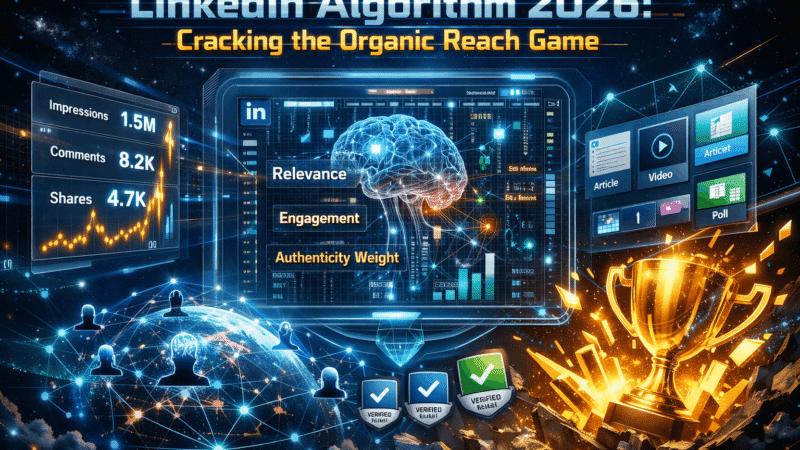
LinkedIn Organic Reach 2026:
Algorithm Changes, Real Statistics & Strategies That Work
LinkedIn’s algorithm has evolved dramatically. Here’s everything you need to know — from organic reach statistics and the 2025–2026 algorithm changes to B2B tactics and what actually moves the needle today.
What’s in This Guide
- What Is LinkedIn Organic Reach?
- LinkedIn Organic Reach Statistics 2026
- Algorithm Changes 2025–2026
- Is LinkedIn Organic Reach Declining?
- Best Content Formats for Reach
- LinkedIn Organic Reach for B2B in 2026
- Company Page vs. Personal Profile Reach
- 7 Proven Strategies to Maximize Reach
- LinkedIn & AI Search Engines (AEO/GEO)
What Is LinkedIn Organic Reach — and Why Does It Matter in 2026?
LinkedIn organic reach refers to the number of unique users who see your content without any paid promotion. Unlike paid reach — boosted posts or sponsored content — organic reach is driven entirely by the platform’s algorithm, your audience size, and the quality of what you post.
In 2026, LinkedIn has over 1.1 billion members across 200+ countries, making it the world’s largest professional network. For businesses, marketers, and professionals, organic reach on LinkedIn is arguably more valuable than on any other social platform — because the audience consists of decision-makers, executives, and buying-intent professionals.
Getting your content seen organically by the right people means more leads, more trust, and more opportunities without spending a single dollar on ads.
LinkedIn Organic Reach Statistics 2026
Before crafting your strategy, it’s important to understand where the numbers stand. Here are the most reliable benchmarks for LinkedIn organic reach performance in 2026:
LinkedIn’s 2026 algorithm heavily weights dwell time — how long someone pauses on your post — over simple likes. A post that makes someone stop and read for 8+ seconds is ranked significantly higher than one that receives several rapid likes with no actual reading time.
These benchmarks highlight a critical truth: LinkedIn organic reach is still very much alive and valuable in 2026 — but it rewards quality, consistency, and genuine engagement over shortcuts and broadcast-style posting.
|
3–7%
Average organic reach rate for company pages per post
|
2–3×
Higher organic reach on personal profiles vs. company pages
|
10–15%
Reach for top-performing rich-media & carousel posts
|
|
6×
More impressions for LinkedIn video vs. static image posts
|
~1B
Impressions generated weekly in LinkedIn feeds globally
|
41%
Of B2B marketers say LinkedIn drives the most qualified leads of any social channel
|
LinkedIn Algorithm Changes 2025–2026: What’s New?
LinkedIn has made several significant algorithm updates between 2025 and 2026. Understanding these shifts is crucial to adapting your content strategy and maintaining — or growing — your organic reach.
|
Algorithm Factor
|
Change vs. 2024
|
Impact on Reach
|
|---|---|---|
|
Dwell Time / Read Time
|
↑ Higher Weight
|
Posts that hold attention rank much higher in feed
|
|
Comments & Replies
|
↑ Stronger Signal
|
Thoughtful comment threads boost distribution 3–4×
|
|
Outbound Links in Posts
|
↓ Penalized
|
Posts with URLs in the body see reduced reach
|
|
Personal Profile Content
|
↑ Prioritized
|
Personal profiles consistently outreach company pages
|
|
Document / Carousel Posts
|
↑ Strong Boost
|
Highest organic reach format in 2026 alongside video
|
|
Promotional Content
|
↓ Suppressed
|
“Buy now” type posts are deprioritized significantly
|
|
Generic AI-Generated Content
|
↓ Demoted
|
Template-like AI content receives lower distribution
|
|
Niche / Specific Expertise
|
↑ Rewarded
|
Expert posts shown to highly relevant audiences
|
LinkedIn’s algorithm runs every post through three stages: 1) Quality Filter (spam and AI-generic check), 2) Small Audience Test (shown to ~1% of your network to measure engagement signals), and 3) Wider Distribution (if initial signals are strong, pushed to 2nd and 3rd-degree connections). The faster your post earns comments in the first 60–90 minutes, the broader the distribution wave.
The “Relevance Graph” Update
One of the most important changes in LinkedIn’s 2025–2026 algorithm is a shift from a purely connection-based feed to what LinkedIn calls a relevance graph. Your posts can now reach people you are not connected to — as long as LinkedIn determines the content is highly relevant to their professional interests, role, or industry. A well-crafted post on a niche topic can now organically reach tens of thousands of your ideal audience, not just your existing followers.
Is LinkedIn Organic Reach Declining in 2026?
This is one of the most searched questions about LinkedIn in 2026 — and the honest answer is: it depends entirely on what kind of content you’re posting.
“Organic reach hasn’t declined — mediocre content has just lost its free pass. Quality, relevant, human-first content is reaching more people than ever before on LinkedIn.”
The organic reach decline narrative is largely a story about declining reach for low-effort content. LinkedIn in 2026 is actually rewarding creators and brands that produce genuinely useful, specific, and engaging content with better distribution than ever — especially to non-followers via the relevance graph.
|
What has DECLINED in reach:
|
What has INCREASED in reach:
|
Best Content Formats for LinkedIn Organic Reach in 2026
Not all content is treated equally by LinkedIn’s algorithm. Based on 2026 performance data, here is a clear ranking of which formats drive the most organic reach:
|
Content Format
|
Organic Reach Score
|
Best Use Case
|
|---|---|---|
|
Document / Carousel Post
|
★★★★★ Excellent
|
How-tos, frameworks, data, visual lists
|
|
Native Video (Short-form)
|
★★★★★ Excellent
|
Explainers, hot takes, behind-the-scenes
|
|
Long-form Text (Narrative)
|
★★★★ Very Good
|
Personal stories, lessons learned, opinions
|
|
LinkedIn Newsletter
|
★★★★ Very Good
|
Thought leadership, industry deep dives
|
|
Polls
|
★★★ Good
|
Audience research, debate-sparking questions
|
|
Single Image Posts
|
★★★ Good
|
Infographics, quotes, stats
|
|
Link Posts (link in body)
|
★★ Limited
|
Better to post link in first comment
|
|
Pure Reshares (no commentary)
|
★ Very Low
|
Avoid — algorithm heavily deprioritizes these
|
LinkedIn Organic Reach for B2B in 2026: The Full Playbook
LinkedIn remains the undisputed king of B2B social media marketing. For B2B companies looking to maximize organic reach in 2026, the playbook has shifted significantly from brand-level broadcasting to human-first, expertise-led content.
For a B2B company page with 5,000 followers, a “good” post should aim for 500–1,500 impressions organically. Top-performing posts with strong engagement can reach 5,000–25,000+ impressions via the relevance graph. Consistently below 300 impressions per post? It’s time to audit your content strategy.
|
1
|
Activate Employee AdvocacyContent posted by individual employees consistently reaches 5–10× more people than the same content posted from a company page. Build a structured employee advocacy program where team members regularly share and comment on company content with their own genuine commentary. |
|
2
|
Publish Original Research & DataOriginal data — even small-scale surveys of your own customer base — generates massive organic reach because it’s shareable, citable, and newsworthy. A post sharing “we surveyed 200 CFOs and here’s what surprised us” consistently outperforms any promotional post. |
|
3
|
Launch a LinkedIn NewsletterLinkedIn Newsletters enjoy two distribution advantages: they appear in the regular feed AND generate direct subscriber notifications. In 2026, newsletters are one of the highest-reach formats available to both company pages and personal profiles. Power Your LinkedIn Company Page Buy Company Page Followers |
|
4
|
Maintain a 5:1 Value-to-Promotion RatioFor every promotional post, publish at least five pieces of genuinely valuable, non-promotional content. The algorithm penalizes accounts that consistently push promotional content. Fill your feed with education, insight, and entertainment. |
|
5
|
Engage in Comments Within the First HourThe LinkedIn algorithm gives heavy weight to comment activity in the first 60–90 minutes after posting. Being present and actively replying to every comment in that window dramatically boosts your post’s distribution wave. |
LinkedIn Company Page Organic Reach 2026: What to Expect
LinkedIn company pages have historically had lower organic reach than personal profiles — and this remains true in 2026. However, company pages have seen some positive changes in how the algorithm distributes their content, particularly for document posts and video.
What Actually Works for Company Page Reach in 2026
|
✓
|
Posting consistently 3–5 times per week — consistency signals an active, valuable presence to the algorithm
|
|
✓
|
Using document/carousel posts as your primary format — they receive the highest algorithmic boost for pages
|
|
✓
|
Encouraging employees to like and comment immediately after posting — early engagement triggers wider distribution
|
|
✓
|
Adding a “link in comments” CTA instead of embedding URLs in the post body
|
|
✓
|
Using 3–5 specific, niche hashtags rather than broad or overused ones
|
|
✓
|
Responding to every comment within 24 hours to keep the engagement thread alive
|
|
✓
|
Celebrating milestones, case studies, and client results — these get shared organically far more than product posts
|
7 Proven Strategies to Maximize LinkedIn Organic Reach in 2026
These aren’t generic tips — these are the strategies consistently working in 2026 based on algorithm behavior and top-creator performance data.
1. Hook Them in the First Two Lines
LinkedIn shows roughly 2–3 lines of any post before the “See more” cutoff. Those first two lines are your entire organic reach bet. Write them to create curiosity, tension, or a specific promise. “3 things I wish I knew before scaling to $1M ARR” beats “Excited to share some thoughts on entrepreneurship” every single time.
2. Use the Engagement Comment Strategy
Ask a specific, relevant question at the end of your post — but make it easy to answer. Not “what do you think?” but “which of these two approaches do you use more often: A or B?” Binary questions dramatically increase comment rates and, therefore, algorithmic distribution.
3. Post at the Right Time for Your Audience
Peak LinkedIn engagement globally is between 7–9 AM and 5–7 PM on Tuesday through Thursday. That said, your LinkedIn analytics should always override generic advice — check when your specific followers are most active.
4. Repurpose Top-Performing Content Across Formats
If a text post performs well, turn it into a carousel. If a carousel performs well, turn it into a short video. If a video performs well, write a newsletter edition about it. This content multiplication strategy consistently delivers strong organic reach across different audience segments.
5. Build Genuine Relationships Through Commenting
Spending 20–30 minutes per day leaving substantive, thoughtful comments on posts from others in your industry dramatically increases your own visibility. LinkedIn’s algorithm notices your activity level, and other creators’ audiences discover you through your comments.
6. Leverage LinkedIn Events and Live Sessions
LinkedIn Events and LinkedIn Live receive special promotional treatment from the algorithm. Hosting or co-hosting a LinkedIn Live session typically generates 6–7× the organic reach of a standard post, and LinkedIn actively notifies your followers when you go live.
7. Grow Your Follower Base Strategically
Organic reach is partly a numbers game — the larger and more engaged your follower base, the wider the initial distribution wave of every post you publish. Building a strong, relevant follower count creates a compounding organic reach advantage over time.
With LinkedIn’s relevance graph, your initial audience size determines how quickly a post enters the wider distribution wave. Accounts with larger, more engaged follower bases consistently see content pushed further — because early engagement from followers triggers the algorithm to show that post to non-followers with similar professional interests. Growing your audience isn’t vanity — it’s organic reach infrastructure.
LinkedIn & AI Search Engines in 2026: The AEO Opportunity Nobody Is Talking About
Here’s a major development that has fundamentally changed the value of LinkedIn content in 2026 — one that most marketers are still sleeping on.
AI-powered search engines and assistants — including Perplexity AI, Google Gemini, ChatGPT (with browsing), and Microsoft Copilot — are now indexing and citing LinkedIn posts, articles, and company pages in their responses. This means a well-written LinkedIn post on a professional topic can now appear in AI-generated answers seen by thousands of people who never even visit LinkedIn directly.
This makes LinkedIn content a direct input to Answer Engine Optimization (AEO) and Generative Engine Optimization (GEO). Your LinkedIn presence is now a core part of your AI search strategy, whether you plan for it or not.
What This Means for Your LinkedIn Strategy
AI engines prefer content with clear structure. For maximum AEO visibility: start with a clear statement of the topic, use short paragraphs with one idea each, include at least one specific stat or data point, and end with a clear takeaway. This is exactly how AI tools extract and cite information when building answers.
- Write for humans first, structure for AI: Clear headers, specific facts, and concrete statistics make your LinkedIn articles much more likely to be cited by AI engines
- Publish LinkedIn Articles, not just posts: Long-form articles are more deeply indexed and cited by AI tools than short posts
- Include original data and statistics: AI engines specifically seek out original research and data points to support their answers
- Company pages are indexed too: Your LinkedIn company page content feeds into AI-generated answers about your brand and industry
- Post consistently: A consistent publication presence signals to AI indexing that you are an active, ongoing authority in your domain
One More Lever: The Role of Social Proof in Organic Reach
There’s a factor in LinkedIn organic reach that most guides don’t discuss honestly — social proof. LinkedIn’s algorithm gives extra weight to content from accounts that already show strong signals of credibility and influence. Follower count, engagement history, and profile completeness all factor into how much initial distribution your posts receive.
This is why growing your LinkedIn follower base — especially in the early stages — creates a virtuous cycle: more followers mean more early engagement, more early engagement means wider algorithmic distribution, and wider distribution means even more followers over time. Strategically building a quality follower base at the right time can be the difference between posts that get lost and posts that get found.
Ready to Amplify Your LinkedIn Organic Reach?
Start with a strong foundation. A credible follower count gives your content the early social proof it needs to trigger LinkedIn’s broader distribution — and SMMSurge delivers real, quality LinkedIn followers trusted by thousands of businesses and professionals worldwide.